Summary
Editor's rating
Value: strong hardware, but this 8/128 version feels a bit tight
Looks like a serious handheld, not a toy
Battery: big number, decent real-world endurance
Comfort: good for long sessions, but not feather-light
Display: the OLED and 165 Hz are the star of the show
Performance: Android and emulation run strong, 8 GB RAM is the bottleneck
What you actually get with the Pocket EVO
Pros
- Excellent 7-inch 1080p OLED display with high refresh rate and good brightness
- Strong Android and emulation performance with active cooling to sustain it
- Comfortable Hall Effect sticks and triggers with precise input and no drift so far
Cons
- 8 GB RAM and 128 GB storage feel tight for this price range, microSD almost mandatory
- Noticeable fan noise and some warmth on the back in higher performance modes

Specifications
View full product page →| Brand | AYANEO |
A Switch-sized Android beast in your backpack
I’ve been using the AYANEO Pocket EVO (8GB RAM / 128GB) as my main handheld for about two weeks, mostly for Android games, Game Pass cloud, and some emulation up to Switch/PS2. I’m not a collector, I just like having one device that can handle most stuff when I’m on the sofa or travelling. I came from a Logitech G Cloud and occasionally use a Steam Deck, so that’s my reference point.
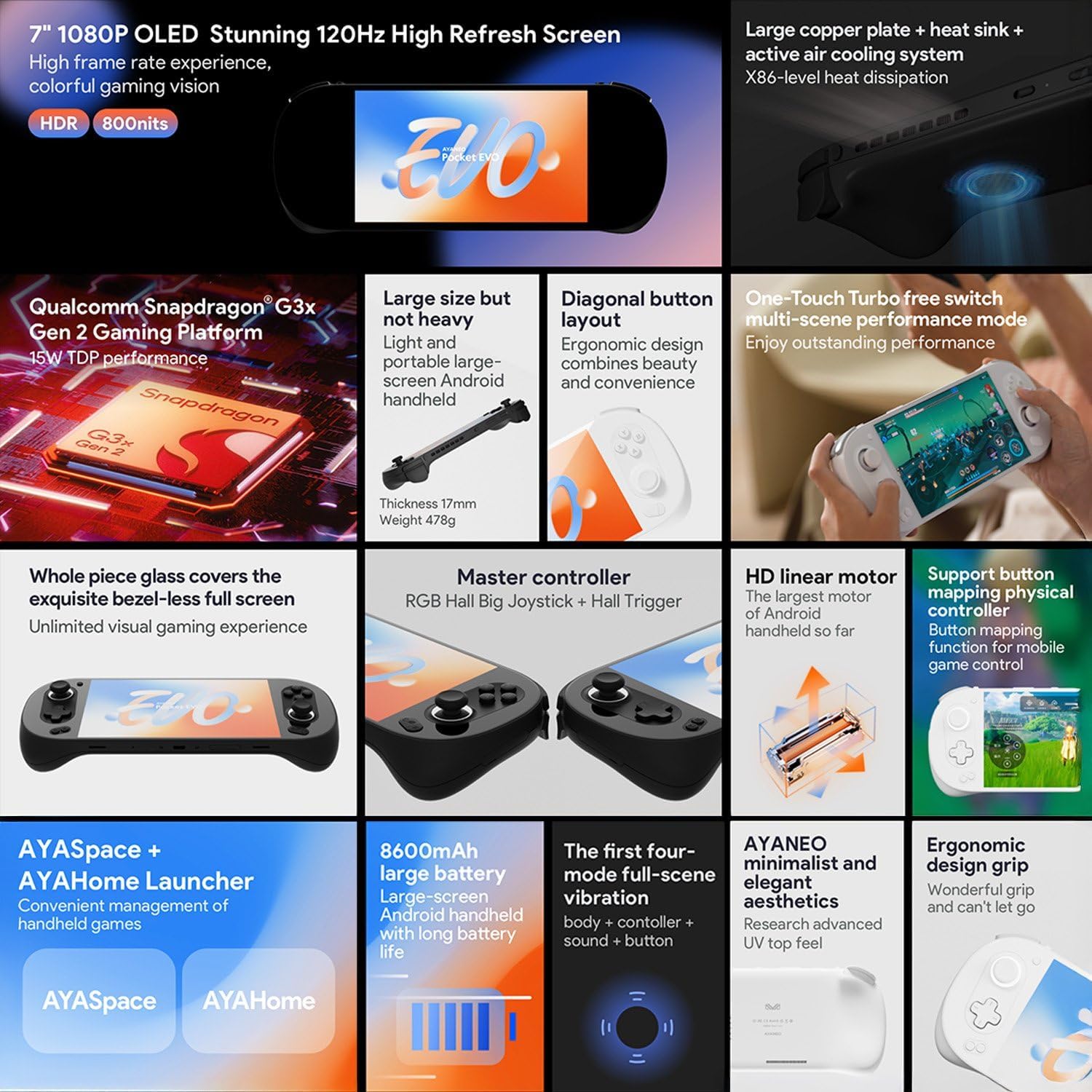
Out of the box, this thing feels like a proper console, not a toy. It’s a bit heavier than it looks on photos, but you can tell there’s serious hardware inside: Snapdragon G3x Gen 2, active cooling, 7-inch 1080p OLED at 165 Hz, Hall sticks, and an 8600 mAh battery. On paper it looks like a beast for Android gaming and cloud streaming. The catch is the 8 GB RAM / 128 GB storage on this version, which is clearly the “base spec”.
During these two weeks I pushed it in a pretty normal way: long evenings of Hades, Dead Cells, some Genshin, a lot of Xbox Cloud Gaming, plus emulation (PSP, PS2, GameCube, Switch for lighter titles). I also tried it as a mini media device for Netflix and YouTube on trips. So this isn’t lab testing; it’s just how I’d actually use it.
Overall, I like it, but it’s not perfect. It’s strong where it needs to be (screen, controls, raw performance), but some choices bug me, especially on storage and thermals, and the software layer is a bit rough in places. If you’re expecting a polished Nintendo-like experience, this isn’t that. If you’re okay tinkering a bit and just want a fast Android handheld, then it starts to make sense.
Value: strong hardware, but this 8/128 version feels a bit tight
Talking about value, you have to keep in mind that AYANEO products are rarely cheap. You’re basically paying for high-end components stuffed into a handheld form factor. With this 8 GB RAM / 128 GB storage version, I feel like they hit a slightly awkward middle point. The chip, screen, cooling, and controls feel high-end, but the memory and storage feel like entry level for the same body. So you’re getting the “nice shell” with the smallest tank of fuel, if that makes sense.
In practical terms, 128 GB fills up fast. A few big Android games, some emulators, and offline media, and you’re already juggling space. Yes, there’s a microSD slot, and I ended up throwing in a 512 GB card, which solves most of the problem, but it’s still extra cost on top of a device that’s already not cheap. For the price bracket this usually sits in, I’d prefer at least 256 GB internal and 12 GB RAM, just to avoid thinking about it. The 8 GB RAM is okay for pure gaming, but doesn’t leave much headroom.
Compared to something like a Logitech G Cloud, this is clearly more powerful and has a far better screen, but it also usually costs more. Compared to Windows handhelds (ROG Ally, Steam Deck, etc.), you’re trading the flexibility of Windows for the lighter weight and longer battery of Android, plus a nicer OLED. If you mainly want cloud gaming and Android titles, this starts to feel like a decent deal. If you want PC gaming too, you might feel limited.
Overall, I’d say the value of this specific 8/128 model is “pretty solid if you know what you’re buying”. You’re paying for the screen, the chip, and the build. But if you’re already spending this kind of money and you’re a heavy user, I’d seriously consider a higher storage/RAM variant if available, or budget for a big microSD right away. It’s not a rip-off, but it’s also not a bargain. It’s for people who are okay paying a bit extra for a premium-feeling Android handheld and don’t mind a bit of tinkering.
Looks like a serious handheld, not a toy
Design-wise, the Pocket EVO sits somewhere between a Switch and a Steam Deck, but slimmer. The black version I have looks fairly low-key: matte body, no loud logos, just a clean handheld with symmetrical sticks and a centered screen. It looks like a device for people who actually play a lot instead of just something made to look flashy on Instagram. I appreciated that, because I don’t really want RGB everywhere when I’m playing on a train.
The layout is pretty standard: sticks on both sides of the screen, D-pad on the left, ABXY on the right, shoulder buttons and triggers up top, plus some extra buttons for Android navigation and AYASpace. The Hall Effect sticks are placed high enough that my thumbs rest naturally without clawing, and the D-pad is close enough that I can switch between them without shifting my grip too much. There are vents on the back and top for the active cooling, which you do notice visually, but it doesn’t look cheap or cluttered.
One thing I liked is that the bezels around the screen are reasonably thin, so the device doesn’t feel like a giant frame around a tiny display. The “borderless” description is a bit optimistic, but compared to older handhelds, it’s definitely tighter. The RGB rings around the sticks are there, but you can tune or disable them, which I did pretty quickly. I prefer the device looking neutral, and I don’t need glowing circles in my face when I’m playing in bed.
In practice, the design choice that matters most is size and weight balance. At almost 480 g, this is not a featherweight, but the weight is spread well enough that it doesn’t feel like it’s dragging forward. After about an hour, I felt the weight more in my wrists compared to my Logitech G Cloud, but still less strain than with a Steam Deck or ROG Ally. Overall, the design is functional and mature. It’s not going to blow you away visually, but it looks and feels like a serious handheld that’s built to be used, not just looked at.
Battery: big number, decent real-world endurance
The Pocket EVO packs an 8600 mAh battery, which looks huge on paper for a handheld. In reality, it’s good but not magic, mainly because the chip, cooling and 165 Hz OLED all draw power when pushed. With mixed use (cloud gaming, some native Android titles, some emulation), I usually got around 4 to 5 hours of play time on a balanced performance mode and around 50–70% brightness. That’s decent, but you’re not getting a full day of heavy gaming without touching a charger.
When I locked the refresh rate lower and stuck to cloud gaming or lighter indie titles, I could push it closer to 6 hours, but that required being a bit conscious of settings. For demanding Android games or emulation at higher performance profiles, it can drop to 3 hours or so. So the big battery mostly compensates for the powerful hardware rather than giving you insane endurance. It’s still better than some Windows handhelds I’ve tried, but not miles ahead of them.
Charging is at least reasonable thanks to PD fast charging over USB-C. With a decent PD charger, I went from about 15% to 80% in a bit under an hour, which is fine for a quick top-up between sessions. It’s not phone-level fast, but given the capacity, I’m okay with it. The device also doesn’t get crazy hot while charging if you’re not playing at the same time, which is good.
In day-to-day use, I’d say the battery is “good enough but not mind-blowing”. You can do a long commute, a flight, or an evening on the couch without stressing too much, but if you’re travelling all day and gaming a lot, you’ll want a power bank. The 8600 mAh spec sounds huge, but with this screen and chip, it just brings you to a solid middle ground rather than crazy endurance.
Comfort: good for long sessions, but not feather-light
Comfort was one of my main concerns because I tend to play for long chunks of time. At 478 g, the Pocket EVO is not ultra-light, but the shape saves it. The grips on the back are subtle but present, so you’re not just pinching a flat slab like with a phone controller. My hands are medium-sized, and I could reach all the main buttons without stretching. Compared to my Steam Deck, this is easier to hold one-handed briefly (like when pausing a game to check my phone), but you still feel that it’s a solid chunk of hardware.
The Hall Effect joysticks and triggers help a lot with comfort because they’re smooth and don’t have that gritty feel some cheaper sticks get. The 250 Hz return rate stuff is marketing to me, but in practice the sticks feel responsive and precise. I didn’t feel any dead zones or random drift during my two weeks, which is already better than my old Switch Joy-Cons. The triggers have a nice consistent pull, not too stiff, not squishy, which matters in racers and shooters.
I did notice the active cooling in terms of both noise and warmth. The fan is not crazy loud, but in a quiet room you definitely hear a small whoosh at higher performance modes. The back gets warm, especially near the top vents, but it never reached a point where I had to put it down. Still, during a longer PS2 emulation session, my palms got a bit sweaty partly because of the heat. If you’re sensitive to fan noise, this might annoy you, but it’s still better than a throttling device that just gets hot and slow.
As for long sessions, I’d say it’s comfortable up to about 1.5–2 hours straight before the weight starts to bother me. Lying down in bed, it’s more tiring than something like the G Cloud, but less than a Steam Deck. I also appreciated that the buttons and sticks are slightly raised and not cramped, so my thumbs didn’t cramp up. Overall, comfort is pretty solid, just don’t expect “forget it’s in your hands” lightness. It’s a powerful handheld, and your wrists will remind you of that after a while.
Display: the OLED and 165 Hz are the star of the show
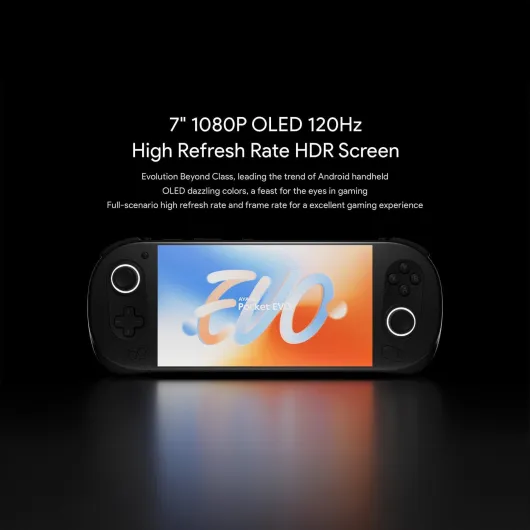
The 7-inch 1080p OLED at 165 Hz is easily the highlight of the Pocket EVO. Colors look punchy without going totally cartoonish, blacks are deep, and the 1080p resolution on 7 inches is a good sweet spot: sharp enough that text and UI elements look clean, but not so high that it murders performance. I never felt like I was staring at pixels, even in small text in emulators or Android menus. Compared to the LCD on my older handhelds, this is a clear step up.
The high refresh rate is nice, but not every game will use it. For titles that support 90/120 fps or more, motion looks very smooth and responsive. Scrolling through menus and Android in general also feels snappier just because of the refresh rate. That said, you do pay a battery cost if you leave it at 165 Hz all the time, so I ended up using a lower refresh rate profile for slower games and media, and bumping it up for fast-paced stuff where it actually matters.
Brightness is listed at up to 800 nits, and in practice it’s usable outdoors, especially in the shade. Direct sunlight is still tough, like with most handhelds, but at least it doesn’t look washed out as badly as some LCD competitors. Indoors at around 50–60% brightness it’s plenty. HDR support is there, and some content looks nice with it, but it’s not the main selling point for me; the OLED contrast alone already makes games feel more “alive” compared to flat LCD panels.
The screen is also fully laminated and protected by glass, which cuts down on reflections a bit and makes touch input feel closer to the actual pixels. I didn’t notice weird touch issues or missed inputs. Overall, the display is probably the main reason to pick this over cheaper Android handhelds. If screen quality matters to you, this is where the Pocket EVO really justifies itself.
Performance: Android and emulation run strong, 8 GB RAM is the bottleneck
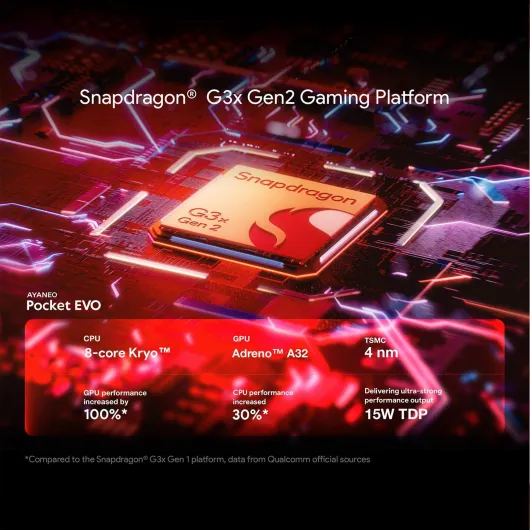
On raw performance, the Pocket EVO does what you’d expect from a device with the Snapdragon G3x Gen 2 and active cooling. Android games that support higher frame rates run very smoothly. In titles like Dead Cells, Hades, and some shooters that unlock 120+ fps, the 165 Hz screen actually makes sense: you feel the smoothness. For heavier games like Genshin Impact, I had to tweak settings a bit, but it stayed playable at decent visuals without massive stutters. It’s clearly stronger than my Logitech G Cloud, and closer to a modern high-end phone dedicated to gaming.
Cloud gaming is where it really shines. With good Wi‑Fi, Xbox Cloud Gaming and GeForce NOW ran very cleanly. The Wi‑Fi module seems solid; I didn’t see random drops that I sometimes get on cheaper Android handhelds. Input lag is more about your internet connection than the device. Paired with a 165 Hz OLED, streaming 60 fps or 120 fps titles feels very responsive. If your main goal is Game Pass and cloud PC gaming, the performance here is more than enough.
On emulation, I tested PSP, GameCube/Wii, PS2, and some Switch (lighter titles). PSP and below are obviously fine. GameCube and many PS2 games run well with the right settings, and the active cooling helps sustain performance so it doesn’t tank after 20–30 minutes. Switch emulation is more hit-or-miss and very dependent on the specific game and emulator updates, but lighter indie or 2D stuff is okay. It’s not a magic Switch replacement, but for retro and up to PS2/GC, it’s strong.
The main limitation is 8 GB of RAM. Multitasking and switching between heavy games and AYASpace can feel a bit tight. If you keep a lot of apps open, you’ll see reloads. For pure gaming it’s tolerable, but at this price point, 12 GB would simply make more sense. I never hit a point where the device became unusable, but you can feel that there isn’t a ton of headroom. Still, for a focused gaming use, performance is solid and clearly above “just a phone with a controller” territory.
What you actually get with the Pocket EVO
The Pocket EVO is basically an Android console with phone guts tuned for gaming. This base model has 8 GB of LPDDR5X RAM and 128 GB of UFS 3.1 storage, plus a microSD slot if you need more space. Inside it runs the Snapdragon G3x Gen 2, which is basically a gaming-focused variant of Qualcomm’s mobile chips, and it’s paired with an active cooling system, so there’s a fan and actual heatsink fins inside. It runs Android with AYANEO’s AYASpace and AYAHome launcher on top to manage games and performance profiles.
The front is dominated by the 7-inch 1080p OLED display with a claimed 165 Hz refresh rate and up to 800 nits brightness. That’s more than enough for indoor use and even usable outdoors in the shade. Controls are classic: twin Hall Effect joysticks, Hall triggers, ABXY, D-pad, plus the usual Android navigation buttons and some extra function buttons tied into AYASpace. There’s RGB lighting around the sticks if you’re into that kind of thing, and a fairly chunky vibration system with several modes, though I mostly left it on a basic setting.
On the connectivity side, you get Wi-Fi, Bluetooth 5.3, and a USB-C 3.2 Gen 2 port that handles data and charging. I tested it with a USB-C hub for HDMI-out to a TV and it worked fine for light couch play, though Android scaling is always a bit awkward on big screens. The device weighs about 478 g and measures roughly 260.5 x 100 x 17 mm, so it’s roughly in the same ballpark as a Switch with bigger grips and a nicer screen.
In practice, this config feels like a mid-tier spec of a high-end product. The chip and screen feel high-end, but 8 GB RAM and 128 GB storage feel tight for 2026, especially once you start loading emulators, big Android games and offline media. You can work around it with a large microSD card, but it still feels like AYANEO cheaped out a bit on this base version. It’s usable, but you do have to manage space and background apps more than I’d like on a device in this price range.
Pros
- Excellent 7-inch 1080p OLED display with high refresh rate and good brightness
- Strong Android and emulation performance with active cooling to sustain it
- Comfortable Hall Effect sticks and triggers with precise input and no drift so far
Cons
- 8 GB RAM and 128 GB storage feel tight for this price range, microSD almost mandatory
- Noticeable fan noise and some warmth on the back in higher performance modes
Conclusion
Editor's rating
After two weeks with the AYANEO Pocket EVO 8GB/128GB, my feeling is that it’s a very capable Android handheld with a few clear compromises. The screen, controls, and performance are the strong points. The 7-inch 1080p OLED at 165 Hz is genuinely nice to look at, the Hall Effect sticks and triggers feel precise, and the Snapdragon G3x Gen 2 with active cooling handles Android gaming, cloud streaming, and emulation up to PS2/GC very well. As a pure gaming machine, it gets the job done and then some.
On the downside, this specific configuration feels a bit cramped. 8 GB of RAM and 128 GB of storage are usable, but you quickly feel the limits if you install a lot of games and apps. The device is also not super light, and the fan is audible in higher performance modes, so if you want something totally silent and featherweight, this isn’t it. AYASpace and the custom launcher are helpful for organizing games, but they still feel a bit more “enthusiast” than “plug-and-play console”.
If you mainly want a powerful Android handheld for cloud gaming, retro emulation, and modern Android titles, and you care a lot about having a good screen and solid controls, the Pocket EVO makes sense. Just be ready to add a big microSD card and to tweak settings a bit. If you’re on a tight budget, or you prefer a more console-like, simple experience, you might be happier with a cheaper Android handheld or a Switch. For tinkerers and power users, though, this is a pretty strong option with clear strengths and manageable flaws.