Summary
Editor's rating
Value for money: nostalgia tax is real here
Design: looks like a grown-up Game Boy, feels like real hardware
Battery life: good, but not endless
Build quality and durability: premium feel, a few concerns
Performance: how it actually runs Game Boy, GBC and GBA games
What the Analogue Pocket actually is (and what it isn’t)
Pros
- Excellent high-resolution screen with multiple display modes tailored for GB/GBC/GBA
- Very accurate hardware-level performance with original cartridges and no noticeable lag
- Solid build quality, mappable buttons, USB-C charging and good sleep mode behavior
Cons
- High price, especially with Amazon markups and extra cost for dock/adapters
- Requires firmware updates and some tinkering to get the best experience
- Limited value if you don’t already own original game cartridges

Specifications
View full product page →| Brand | Generic |
A fancy Game Boy for people who never got over Pokémon
I’ve been using the Analogue Pocket Black for a few weeks now, mostly with my old Game Boy, Game Boy Color and GBA carts that were sitting in a box. If you strip away all the hype, it’s basically a very high-end Game Boy that costs way more than the original hardware or the usual Chinese emulators. So the real question for me was simple: is the experience good enough to justify the price and the hassle of hunting one down?
Out of the box, it feels like a serious bit of kit, not a toy. You turn it on, pop in an old Pokémon or Castlevania cart, and it just boots. No weird lag, no random emulation glitches. That part is honestly what sold me after a few days: it behaves like original hardware, just with a much cleaner screen and better sound. If you’ve used cheap emulation handhelds, you’ll notice the difference fast.
But it’s not perfect. The console itself is solid, but the whole ecosystem around it is a bit of a mess: stock issues, big price markups on Amazon, and you basically need to update the firmware on day one or some games don’t behave correctly, especially Game Boy Color. On top of that, if you don’t already own cartridges, you’re going to end up tinkering with firmware and SD cards, which isn’t super beginner friendly.
So my first impression in short: great device, niche product. If you just want to casually play a few old games, this is probably overkill. If you’re picky about image quality and you still have a drawer full of original carts, it starts to make more sense. The rest of this review is just me going through how it actually feels to use it every day: design, performance, battery, and whether I think it’s worth the money.
Value for money: nostalgia tax is real here
This is where things get tricky. On paper, the Analogue Pocket is not cheap, and on Amazon it’s often downright expensive compared to the official price. One reviewer mentioned paying around 500€ on Amazon because it was easier than dealing with the manufacturer’s site and import fees, while the official price is just over 200 dollars. That’s a huge gap. At the official price, I’d say it’s a premium toy but still somewhat justifiable if you care a lot about retro gaming. At the inflated marketplace prices, it starts to feel like you’re paying a heavy nostalgia tax.
What you get for the money is: top-tier screen for retro handhelds, very accurate hardware-level performance, solid build quality, and a growing ecosystem with firmware updates and community support. If you already own a bunch of original carts and you want the best way to play them on modern hardware without going full emulator on a phone or PC, the value is decent. It’s not cheap, but you can feel where the money went when you hold it and use it. Compared to a random emulation handheld that costs a third of the price, the Pocket feels cleaner, more precise, and less janky.
But if you don’t have cartridges and you’re mainly thinking “I want to play old games somehow,” then the value drops hard. You’ll either have to buy original carts (which are getting pricey) or start tinkering with firmware and SD cards to run other stuff. At that point, cheaper emulation devices or even a hacked 3DS/PSP might make more sense for you. Also, keep in mind that the dock for TV output and the system adapters (Game Gear, Neo Geo Pocket Color, etc.) are sold separately and usually only on Analogue’s site. So the total bill can climb pretty fast if you want the full setup.
So my honest take: the Analogue Pocket is good value only for a specific type of user. If you’re a retro handheld nerd, care about accuracy and image quality, and already have games lying around, it’s a solid investment at the official price. If you’re just curious or on a budget, or if you’d be paying scalper prices on Amazon, I’d say skip it or wait. There are cheaper ways to scratch the nostalgia itch that hurt your wallet a lot less.
Design: looks like a grown-up Game Boy, feels like real hardware
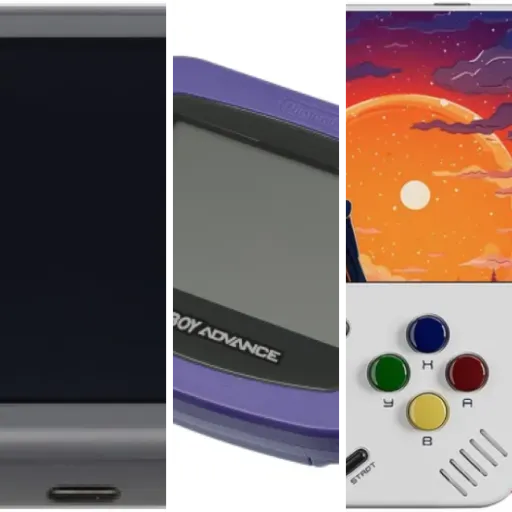
In terms of design, the Analogue Pocket basically looks like a modern, cleaned-up Game Boy. Rectangular slab, screen on top, d-pad and buttons on the bottom. The black version I have is very low-key: no flashy logos, no weird colors, just a simple matte black front that doesn’t scream “toy”. It’s roughly around the height of a smartphone, but thicker and a bit heavier, so it feels like something you could drop without it shattering instantly. The official dimensions listed are 15.24 x 10.16 x 5.08 cm, which matches how it feels: chunky but not huge.
The main thing that stands out is the 3.5" LCD screen with 1600x1440 resolution at 615ppi. That’s way sharper than any original Game Boy or GBA, obviously, and honestly sharper than it needs to be for these old games. But the upside is you get super clear pixel edges and multiple display modes that mimic the original look (original DMG, GBC, GBA, etc.). In practice, I found myself switching between modes depending on the game: a bit of fake “screen grid” for older titles, cleaner look for GBA stuff. It’s one of those things that sounds like nerdy overkill, but after you get used to it, going back to a real GBA SP makes that old screen look pretty rough.
Button layout is classic: d-pad on the left, A/B (and X/Y) on the right, Start/Select in the middle, plus shoulder buttons on top. All buttons are mappable, which is handy if you don’t like the default layout or if you’re using cores later. The feel of the buttons is closer to a modern controller than an original Game Boy: more clicky, more precise. I didn’t have any missed inputs or weird diagonals in platformers, which is usually the first thing that annoys me on cheap handhelds.
There are some nice small touches: USB-C charging (about time), a 3.5mm headphone jack (thankfully not removed), and a microSD slot on the side for firmware updates and, if you want to go that route, other uses. There’s also a “tate mode” with 360° display rotation for vertical shooters, but that’s pretty niche unless you’re deep into that scene. Overall, the design is simple, functional and feels thought-through, not like a random AliExpress handheld. The only downside for me is that it looks so plain that, at this price, a part of me expected something a bit more special visually, but at least it doesn’t look cheap.
Battery life: good, but not endless
The Analogue Pocket packs a 4300mAh rechargeable lithium-ion battery, and the brand claims around 6–10 hours of gameplay and 10+ hours of sleep time. In my actual use, I’d say that’s roughly accurate, leaning more towards the 7–8 hour range with brightness fairly high and sound at a normal level. If you dim the screen a bit and don’t blast the volume, you can push closer to 9–10 hours. It’s not mind-blowing, but it’s perfectly fine for a couple of evenings of play or a long train ride.
Charging is through USB-C, which is very convenient. I plugged it into the same charger I use for my phone and my Steam Deck, and it charged without any problem. From low battery to full charge took me around 2 to 2.5 hours with a decent charger. There’s no weird proprietary dock needed just for charging, which I appreciate. It also doesn’t seem to heat up too much while charging or playing; it gets slightly warm, but nothing worrying.
Sleep mode is actually what makes the battery feel more practical. You can put the console to sleep instead of fully shutting it down, and it holds the charge in sleep for a long time. I left it in sleep for a couple of days and only lost a small percentage. That means you can treat it a bit like a Switch: play a bit, sleep it, then pick up where you left off without worrying that the battery will be dead the next day. For retro games that don’t always have convenient save points, that’s a real plus.
Bottom line, battery life is solid but not legendary. If you’re used to old Game Boys that ran forever on AA batteries, this won’t feel like that. But compared to modern handhelds with bright screens, it’s decent. You’ll still want to keep a USB-C cable in your bag if you’re traveling, but for normal home use, charging every few days is fine. I never felt like the battery was limiting my sessions, which is all I really care about.
Build quality and durability: premium feel, a few concerns
In the hand, the Analogue Pocket feels sturdy and well put together. The shell doesn’t creak, the buttons don’t wobble, and the cartridge slot holds games firmly without feeling like you’re going to snap anything. It’s definitely a step above the cheap plastic feel of many emulation handhelds you see online. The weight is reassuring without being too heavy, and I’ve tossed it into a bag a few times (in a simple sleeve) without any visible damage so far.
The screen is the part I’m most careful with. It looks great, but like any modern high-res LCD, it’s not something you want to drop face-down on concrete. I’d strongly recommend getting some kind of screen protector or at least a case if you plan to carry it around a lot. One of the Amazon reviewers mentioned paying huge markup prices during the shortage; that alone made me extra cautious, because if you crack this thing, it’s not like replacing a second-hand Game Boy shell for cheap. Repairs and replacements are not as straightforward as older hardware.
Buttons and d-pad have held up well for me so far. I played a few longer sessions of action-heavy games, and there’s no early sign of mushiness or sticking. The shoulder buttons are a bit small but still clicky and solid. The ports (USB-C and headphone jack) also feel decent, no loose connections. Given the price, I expected this level of build quality, and at least on that front, it delivers. You can tell it’s not some no-name clone slapped together in a rush.
My only real durability concern is more about long-term support and availability. If something breaks in three or four years, getting official parts or a repair might be tricky depending on where you live, especially if you didn’t buy directly from Analogue. Also, some Amazon buyers got units that were clearly used or secondhand despite being sold as new, which is not the console’s fault but still a risk when you’re paying a premium. So yeah, the hardware itself feels robust, but I’d still treat it carefully and maybe avoid paying scalper prices on marketplaces if you can help it.
Performance: how it actually runs Game Boy, GBC and GBA games
Performance-wise, this is where the Analogue Pocket just quietly does what it’s supposed to do. Game Boy, Game Boy Color and Game Boy Advance cartridges boot instantly and run smoothly, with no lag or odd behavior that I could notice. I played a mix of Pokémon, Tetris, Wario Land, Castlevania and some random GBA platformers, and they all felt just like on the original hardware, just on a sharper screen. Controls are tight, and the audio timing feels right, which is not always the case on cheap emulation devices.
That said, you should plan to update the firmware pretty much right away. Before the update, some people (and one of the Amazon reviewers) had issues where Game Boy Color games were detected as regular Game Boy games, so they launched without color. I didn’t hit that exact bug, but I did the firmware update on day one just to be safe. The process is straightforward but old-school: download the file from Analogue’s site, drop it on a microSD card, stick it in the console (while it’s off), then power it up and let it update. It’s not hard, but it’s not as friendly as a modern console that updates over Wi-Fi. If you’re not comfortable with this kind of thing, it might annoy you.
One thing people talk about a lot is that the Pocket has two FPGAs, which means it can support extra “cores” for other systems beyond what’s official. I won’t go into details, but yes, the community has already done a lot with that. For a regular user with original carts, you don’t have to care about that at all, but it’s good to know that the hardware is capable and not locked into just three old Nintendo systems. Just be aware: the more you go down that rabbit hole, the more time you’ll spend tinkering with files and configs instead of just playing.
Day to day, performance is basically transparent, which is what you want. No crashes, no freezes, no random slowdowns. Sleep mode works like on a modern handheld: tap the power button, it suspends; tap again, and you’re back where you left off. Combined with the quick boot from cartridges, it makes short sessions very easy. The only real performance complaint I have is not about speed but about availability and price: on Amazon especially, you’re often paying a big premium for the same hardware you could get cheaper from the manufacturer if you’re willing to wait and deal with shipping.
What the Analogue Pocket actually is (and what it isn’t)
The Analogue Pocket is sold as a “multi-video-game-system portable handheld”, but in practice, out of the box it’s mainly a super high-res Game Boy / Game Boy Color / Game Boy Advance. You stick your original cartridges in the slot at the top, and the system runs them using FPGA hardware, not software emulation. That means timing is very close to the original consoles, and games feel “right” in terms of controls and sound. There’s no built-in game store, no ROMs included, nothing like a Switch or a smartphone. If you don’t have carts or don’t want to tinker, it’s basically just a fancy retro handheld with no games.
Analogue also advertises it as a “digital audio workstation with a built-in synthesizer and sequencer”. I’ll be honest: I tried that for 20 minutes, played with a few sounds, and never opened it again. It’s a neat bonus if you’re into chiptune or messing around with music, but for most people it’s going to be a side feature that looks cool in the description and then gets ignored. The main use case is still playing Game Boy-era games with a clean modern screen.
There are adapters (sold separately) for Game Gear, Neo Geo Pocket Color, Atari Lynx and others, but if you’re buying on Amazon at a markup, those accessories may not even be available there. That’s one of the first annoyances: to really get the most out of this thing, you basically need to order from the official site, and then deal with shipping, import fees, and waiting. On Amazon, you’re often paying way more just for the console alone, with no dock, no adapters, nothing.
So in practical terms, here’s how I’d describe it to a friend: it’s a premium Game Boy that can be expanded into a multi-system machine if you’re willing to spend even more money and time. If you were expecting something like a Switch that does retro plus modern, you’re in the wrong place. If you want a very clean way to replay old handheld games and maybe dabble with some music stuff, then it fits that niche pretty well.
Pros
- Excellent high-resolution screen with multiple display modes tailored for GB/GBC/GBA
- Very accurate hardware-level performance with original cartridges and no noticeable lag
- Solid build quality, mappable buttons, USB-C charging and good sleep mode behavior
Cons
- High price, especially with Amazon markups and extra cost for dock/adapters
- Requires firmware updates and some tinkering to get the best experience
- Limited value if you don’t already own original game cartridges
Conclusion
Editor's rating
After using the Analogue Pocket Black regularly, I see it for what it is: a very polished, very specific tool for people who seriously care about old handheld games. The screen is sharp, the controls are precise, and original Game Boy, GBC and GBA carts run like they should. Battery life is decent, build quality feels solid, and firmware updates keep improving things. It’s basically the nicest way I’ve found to play my old Pokémon, Castlevania and other classics without digging out aging hardware with dim screens.
But it’s not a casual toy. The price is high even at the official rate, and on Amazon it can be downright painful. If you don’t already own cartridges, the value is questionable, and you’ll either spend more on games or go down the tinkering route with SD cards and custom cores. The audio workstation part is a niche bonus, not a main reason to buy. Also, the fact that some Amazon buyers got secondhand units sold as new is a red flag if you’re paying a markup just for faster delivery.
So who should get it? If you’re a retro handheld fan with a pile of carts, picky about image quality, and okay with paying for a premium experience, the Analogue Pocket is a pretty solid choice and you’ll likely be happy with it. If you’re just curious about old games, on a budget, or you mainly want plug-and-play with built-in titles, there are cheaper and simpler options that make more sense. In short: great device for a niche audience, overkill for everyone else.