Summary
Editor's rating
Value: worth it for Zelda fans, just okay for everyone else
Design: Zelda fan service without looking too flashy
Battery: solid for commutes, average for long trips
Comfort: great for small to medium hands, just okay for long marathons
Durability: feels solid, but you’ll still want a case
Performance: standard Switch Lite, nothing more, nothing less
What you actually get with this Hyrule Edition
Pros
- Nice Zelda-themed gold design that still looks fairly discreet in daily use
- Lightweight, compact handheld with a proper d-pad and comfortable controls for shorter sessions
- International version works with physical games from any region without issues
Cons
- Handheld-only: no TV output and no detachable Joy-Con for easy multiplayer
- Same hardware as a normal Switch Lite, so no performance or storage upgrade despite the special edition
- Price can be higher than a regular Lite, and you’re mostly paying for the look

Specifications
View full product page →| Brand | Nintendo |
A Zelda-branded Lite I actually want to carry around
I’ve been using the Nintendo Switch Lite Hyrule Edition for a bit now, and I’ll be honest: I mostly bought it for the look, not because I needed another Switch. I already have a regular dockable Switch, so this was more of a mix between a backup console and a Zelda fan purchase. I went in expecting just a normal Lite with a different shell, and that’s basically what it is, but the details do matter if you play a lot in handheld.
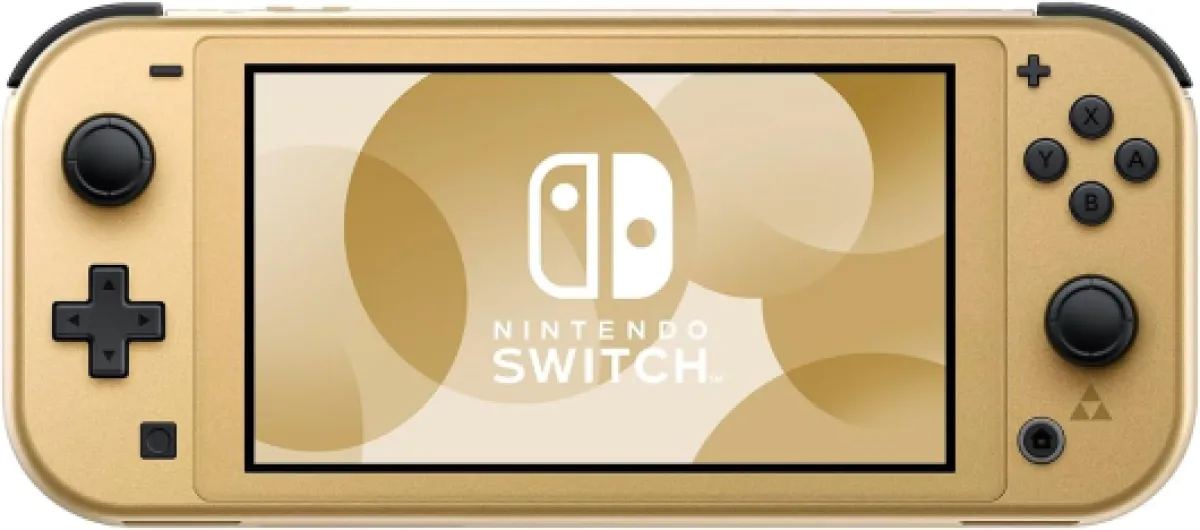
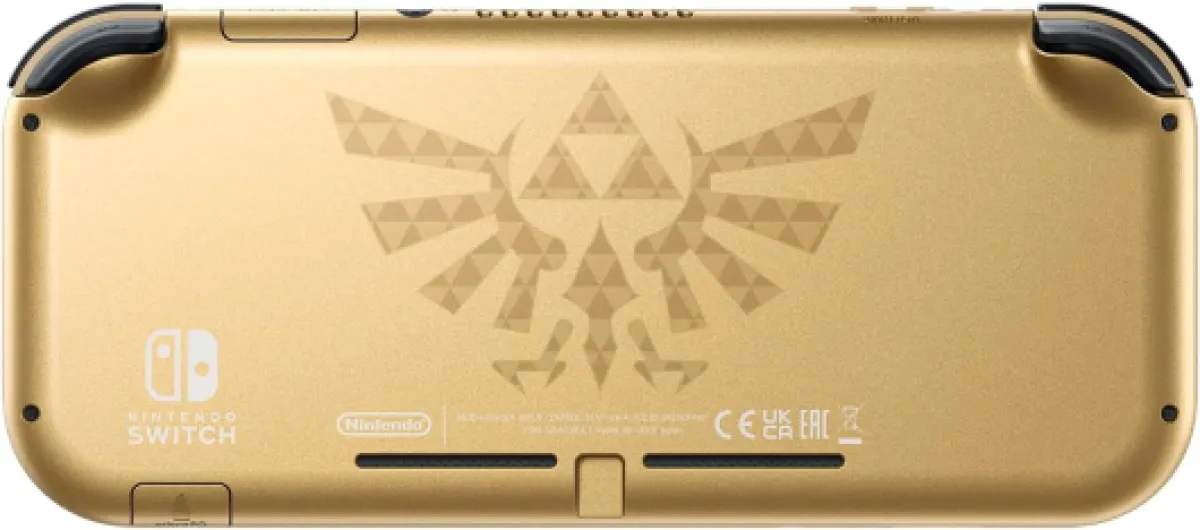
The first thing that hits you is the gold color and the Hylian Crest on the back. It’s not some loud shiny toy gold, it’s more of a muted gold that doesn’t scream in your face, which I appreciated. In daily use, it just looks like a nice themed handheld rather than a kid’s toy. A couple of friends who don’t care about Zelda still said it looked pretty cool, which is a good sign if you don’t want something that looks too nerdy in public transport.
Functionally, it’s the same Switch Lite: no TV output, no detachable Joy-Con, all-in-one body. If you already know the Switch ecosystem, there are zero surprises on that front. It runs the same games, same eShop, same menus. I popped in a couple of physical carts from different regions, and as expected, no region issues. So if you’re buying this as your only Switch, it behaves like any other Lite, just with a different coat of paint.
Overall, my mindset with this thing is: it’s a handheld made for solo players who like Zelda or at least like the color scheme. If you want couch multiplayer or big-screen sessions, this is the wrong model. If you want something light to throw in a bag and grind through Tears of the Kingdom on the bus or in bed, then it starts to make more sense. It’s not perfect, but it does its job pretty well for that specific use case.
Value: worth it for Zelda fans, just okay for everyone else
On the value side, this Hyrule Edition is basically a normal Switch Lite with a themed design and sometimes a slightly higher price, depending on where you buy it. If the price is close to a standard Lite, I’d say it’s a good deal, especially if you like Zelda or just want something that doesn’t look generic. If it’s significantly more expensive than the normal colors, then you really have to ask yourself how much that gold shell and Hylian Crest are worth to you.
Functionally, you’re not getting extra performance, more storage, or a game included out of the box. It’s the same hardware with a different look. So if you don’t care about the Zelda theme at all and just want a cheap handheld Switch, you might as well grab whatever color is on sale. On the other hand, if you’re a collector or a fan of the series, this edition scratches that itch nicely without going into crazy collector’s edition pricing (at least at launch).
Compared to the Zelda OLED model, this Hyrule Lite is more portable and cheaper, but you lose the TV dock and the nicer OLED screen. If you mainly play on the couch in front of a TV, the OLED makes more sense. If you’re buying this as a second Switch just for travel or for a younger family member who doesn’t need TV output, then the Lite makes more financial sense. You’re not paying for features you won’t use.
So in terms of value, my take is pretty simple: if you want a handheld-only Switch and the Zelda look makes you smile, it’s a solid buy when the price is reasonable. If you don’t care about the branding, or you want the flexibility of TV mode, your money is probably better spent on a regular or OLED Switch instead. It’s good value for Zelda fans, average value for everyone else.
Design: Zelda fan service without looking too flashy
Design-wise, this is where the Hyrule Edition actually justifies itself a bit. The gold color is the main thing: it’s more of a matte, slightly muted gold, not a super shiny chrome style. That’s good because it doesn’t pick up fingerprints as badly as a glossy finish, and it doesn’t look cheap in person. The green accents around the sticks and buttons give it a nice contrast without going full cartoon. If you’re into Zelda, you’ll instantly recognize the vibe, but if you’re not, it still just looks like a nice themed device.
The Hylian Crest on the back is large but not screamingly bright. It sits in the center and is clearly visible, but you don’t stare at it while playing anyway. There are also some smaller design details referencing the Triforce and Hyrule, which fans will notice. I like that they didn’t overload the front with logos; the front is mostly clean, which makes it feel less busy. Compared to the Zelda OLED edition, this Lite feels a bit more subdued and portable, while the OLED feels more like something you park in a dock and admire.
In the hands, the layout is exactly the same as any Switch Lite: a proper d-pad on the left instead of four separate buttons, face buttons on the right, and the usual shoulder buttons. For 2D platformers and retro games, that d-pad alone is a big plus over the standard Switch Joy-Con setup. I found myself preferring this Lite for stuff like Celeste or classic SNES games, just because the directional input feels more natural.
One thing to keep in mind: the console is permanently one color. If you’re the type who likes swapping Joy-Con colors to change the look, you obviously can’t do that here. You’re locked into this gold+green combo. I personally like it, but if you think you might get bored of it, that’s worth considering. Overall, the design is nice and practical: clearly themed, but not screaming for attention, and fully usable as a daily handheld without feeling like a novelty toy.
Battery: solid for commutes, average for long trips
The battery life on this Hyrule Switch Lite is in the “good but not crazy” category. Nintendo’s usual range of roughly 3–7 hours depending on the game matches what I’m seeing. With something heavy like Tears of the Kingdom at mid brightness and Wi-Fi on, I was usually hitting around 3.5–4 hours before needing to plug in. With lighter games or indie titles, you can stretch it closer to 5–6 hours if you’re careful with brightness and airplane mode.
For daily use, like 30–60 minutes on the bus or a bit before bed, that’s totally fine. You can go several days without charging if you’re just doing short sessions. For long trips, like a 5–6 hour train ride, you’ll probably either lower brightness, use airplane mode, or bring a power bank. The USB-C port makes it easy enough to charge with any decent phone charger or power bank, so you’re not locked into the original adapter, which is handy.
Charging from low battery to full takes a couple of hours. It’s not lightning fast, but if you plug it in while having dinner or watching something, it’ll be ready again. Heat-wise, the console gets a bit warm near the top during heavier games while charging, but nothing alarming. The fan noise is minimal; in a quiet room you can hear a light whir sometimes, but in normal environments you barely notice it.
In practice, the battery is well-suited to handheld use, just not life-changing. If you’re used to a launch Switch, this feels similar or slightly better. If you’re used to phones with huge batteries, it might feel a bit short. For me, it’s acceptable: it doesn’t constantly stress me out, but I do keep a USB-C cable nearby. No surprises, no hidden flaws, just average Switch Lite battery behavior in a nicer shell.
Comfort: great for small to medium hands, just okay for long marathons
In terms of comfort, the Switch Lite form factor is pretty decent but not flawless. The weight is low, and the unit is compact, so holding it on the couch or in bed is easy. Compared to my regular Switch with Joy-Con attached, this Hyrule Lite feels more balanced and less top-heavy. For short sessions of 30–60 minutes, I had zero issues, and it’s actually nicer than the full-size Switch because you don’t feel like you’re holding a wide plank.
After longer sessions, like two to three hours of Tears of the Kingdom, I did start to feel some hand fatigue, mainly because the console is flat on the back with no real grip. That’s not unique to this edition; it’s the Lite design in general. If you have bigger hands, you’ll probably end up wanting a grip case to add some bulk and contour. Without a case, my ring fingers and pinkies don’t have much to hold onto, so they kind of dangle, which isn’t ideal over time.
The buttons and sticks are comfortable enough. The d-pad is the highlight for me: it’s precise without being too stiff. The analog sticks are the usual small Switch sticks; they’re fine, but still the same design that can drift over time. I didn’t experience drift while testing, but that’s usually a long-term issue, not something you see in a week. The shoulder buttons are easy to reach, though L and R are a bit shallow if you’re used to beefier triggers on other consoles.
Portability-wise, this thing is easy to toss into a small bag. It fits in a standard Switch Lite case, and because of the all-in-one design, you don’t worry about Joy-Con sliding off. On a train, plane, or bus, it’s very manageable. So in practice, comfort is good for everyday use and commutes, but for marathon sessions, you’ll probably want either a grip case or to switch to a dockable Switch on a TV. It’s clearly tuned for short to medium handheld sessions, not six-hour gaming binges in one go.
Durability: feels solid, but you’ll still want a case
Build quality on this Hyrule Edition feels pretty solid for plastic. The body doesn’t creak when you twist it a bit, and there are no obvious gaps in the shell. The matte finish helps hide small scratches and fingerprints better than a glossy one would. That said, it’s still a portable console with a big screen and small sticks, so I wouldn’t throw it naked into a backpack with keys and cables. A simple case is still a smart buy if you plan to travel with it.
The analog sticks are the usual Switch type, which means long-term stick drift is still a concern. I haven’t had it happen yet on this unit, but I’ve seen it on older Switches, so I’m not naive about it. If you play a lot of Zelda or any game with heavy camera use, be prepared that, a couple of years in, you may need repair or replacement sticks. That’s a general Switch issue, not something specific to this edition.
The buttons and d-pad feel sturdy. After a bunch of sessions, there’s no mushiness or weird wobble. The shoulder buttons are also holding up fine. The gold finish hasn’t rubbed off or faded so far, but obviously I haven’t abused it with sand or anything. The printed crest on the back still looks crisp. That said, if you’re super picky about keeping it "like new", any small scratch will annoy you more because this is a themed device, not a plain gray one.
Port-wise, the USB-C connector feels firm, and the game card slot door still closes tightly. I’ve tossed it into a bag in a basic slip case, and it came out fine. So overall, durability seems decent for a portable console: not bulletproof, but no obvious weak point beyond the usual Switch stick concerns. Treat it with basic care, and it should last. If you’re rough on your gear, definitely pair it with a case and maybe a screen protector, especially because the Zelda design makes you care more when it gets dinged.
Performance: standard Switch Lite, nothing more, nothing less
Performance-wise, there is no secret upgrade here. This is a regular Switch Lite under the Zelda shell. Same processor, same RAM, same internal storage. Games like Breath of the Wild and Tears of the Kingdom run the same as on any other non-OLED Switch. Frame rate drops in busy areas are still there, and loading times are the same. If you were hoping this edition somehow ran Zelda better, it doesn’t. It’s simply a themed casing.
The screen is smaller than the regular Switch and OLED, but for a handheld, it’s fine. Colors are decent and brightness is enough for indoor use and shaded outdoor spots. In direct sunlight, like any non-OLED screen, it struggles a bit, but it’s still usable if you crank up the brightness. Going back and forth between this Lite and my OLED Switch, the OLED obviously looks better, but if you only use the Lite, you get used to it quickly. Text in most games is readable; some titles with tiny fonts might be a bit annoying, but that’s more on the game design than the console.
The controls are responsive. I tested a mix of games: action (Zelda, Hades), platformers, and some indie stuff. Inputs felt instant, and I didn’t notice any extra lag compared to my other Switch. Wireless performance is standard: Wi-Fi for downloads and online is fine, but the antenna isn’t miracle-grade. Large game downloads still take a while, especially on slower connections. Local wireless with another Switch worked as expected for multiplayer, though again, you can’t detach Joy-Con, so you need another controller or another console for real shared play.
So overall, performance is exactly what you’d expect from a Switch Lite in 2024: okay for Nintendo games and most indies, but obviously behind current-gen home consoles and PCs. If you’re buying this, it should be for the Nintendo library and the portability, not raw horsepower. For that, it gets the job done, but it doesn’t magically fix the usual Switch limitations.
What you actually get with this Hyrule Edition
In terms of what’s in the box, it’s pretty basic: the console, the charger, and the usual papers. No fancy case, no collector stand, no art book, nothing like that. Some people on Amazon mention getting Nintendo Switch Online included; in my case, there was just the standard leaflet, so I’d treat any bonus code as a nice surprise, not something guaranteed. The model number is HDH-S-DAZAA, which is the usual Lite reference, and the weight is around 580 g boxed, so it’s easy enough to carry around unopened if you’re gifting it.
The big point is that this is an international version, but on a Switch that basically just means: it works, and the cartridges are not region-locked. I’ve thrown in EU and JP carts, and everything launched fine. The system language is set at startup, so you can pick English, French, Spanish, whatever, and you’re good. If you’re used to old consoles where region mattered, forget that here. For digital games, you just set up the account for the region you want, same as any Switch.
As for size, it’s the standard Switch Lite body: smaller than the normal Switch and much lighter than the OLED. It’s clearly designed for handheld only. This isn’t a hybrid console; there is no video output on the bottom port, so even if you plug it into a dock, nothing shows on the TV. Nintendo never advertised it differently, but I still see people confused about this, so it’s worth repeating: this is a handheld only device.
So overall, in presentation terms, it’s pretty straightforward: you’re paying for a normal Switch Lite with a Zelda skin, plus the usual Switch ecosystem. No collector extras inside the box, no special software, no pre-installed Zelda game. If you were expecting some deluxe bundle with accessories, this isn’t that. It’s a regular retail console with themed plastic, and you have to buy the games separately.
Pros
- Nice Zelda-themed gold design that still looks fairly discreet in daily use
- Lightweight, compact handheld with a proper d-pad and comfortable controls for shorter sessions
- International version works with physical games from any region without issues
Cons
- Handheld-only: no TV output and no detachable Joy-Con for easy multiplayer
- Same hardware as a normal Switch Lite, so no performance or storage upgrade despite the special edition
- Price can be higher than a regular Lite, and you’re mostly paying for the look
Conclusion
Editor's rating
The Nintendo Switch Lite Hyrule Edition is basically a regular Switch Lite wrapped in a Zelda skin, and that’s exactly how it behaves. No secret hardware boost, no special software extras – just the usual Lite experience with a gold shell, green accents, and the Hylian Crest on the back. As a handheld, it’s light, easy to carry, and comfortable for short to medium sessions. The d-pad is better than the standard Joy-Con layout for 2D and retro games, and performance is the usual Switch level: good enough for Nintendo titles and indies, but not a powerhouse.
Where it really makes sense is if you’re a Zelda fan or a collector who likes themed hardware. The design is tasteful enough that you can use it daily without feeling like you’re carrying a toy, and it does scratch that “nice to own” itch. Battery life is fine for commutes, durability feels solid as long as you’re not reckless, and the international version works with carts from everywhere. On the downside, you’re locked into handheld mode only, no TV output, no detachable Joy-Con, and the smaller screen won’t please everyone. It’s also not the best raw value if it’s much pricier than a plain Lite.
If you mainly play solo in handheld and you like the Zelda theme, this is a pretty solid choice. If you want big-screen play, couch multiplayer, or don’t care about the design, you’re better off with a standard or OLED Switch. It’s a nice handheld for a specific type of user, not a universal upgrade for everyone.