Summary
Editor's rating
Value for money: worth it if you want Nintendo games and portability
Design: practical, a bit toy-like, but it works
Battery life: decent, but varies a lot by game
Durability: solid console, but Joy-Con are the weak point
Performance: good for Nintendo games, limited for heavy stuff
What you actually get with this Switch
Pros
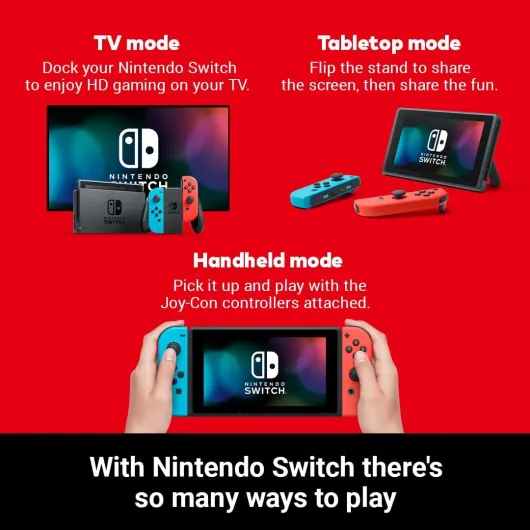
- Hybrid design that lets you switch quickly between TV, handheld, and tabletop modes
- Strong library of Nintendo exclusives and indie games that suit the hardware well
- Portable, easy to pick up for short sessions, and simple interface
Cons
- Joy-Con durability issues (drift) are common and can lead to extra costs
- Weaker performance and graphics compared to other modern home consoles
- Battery life is only average for heavy games in handheld mode

Specifications
View full product page →| Brand | Nintendo |
A console that actually leaves the living room
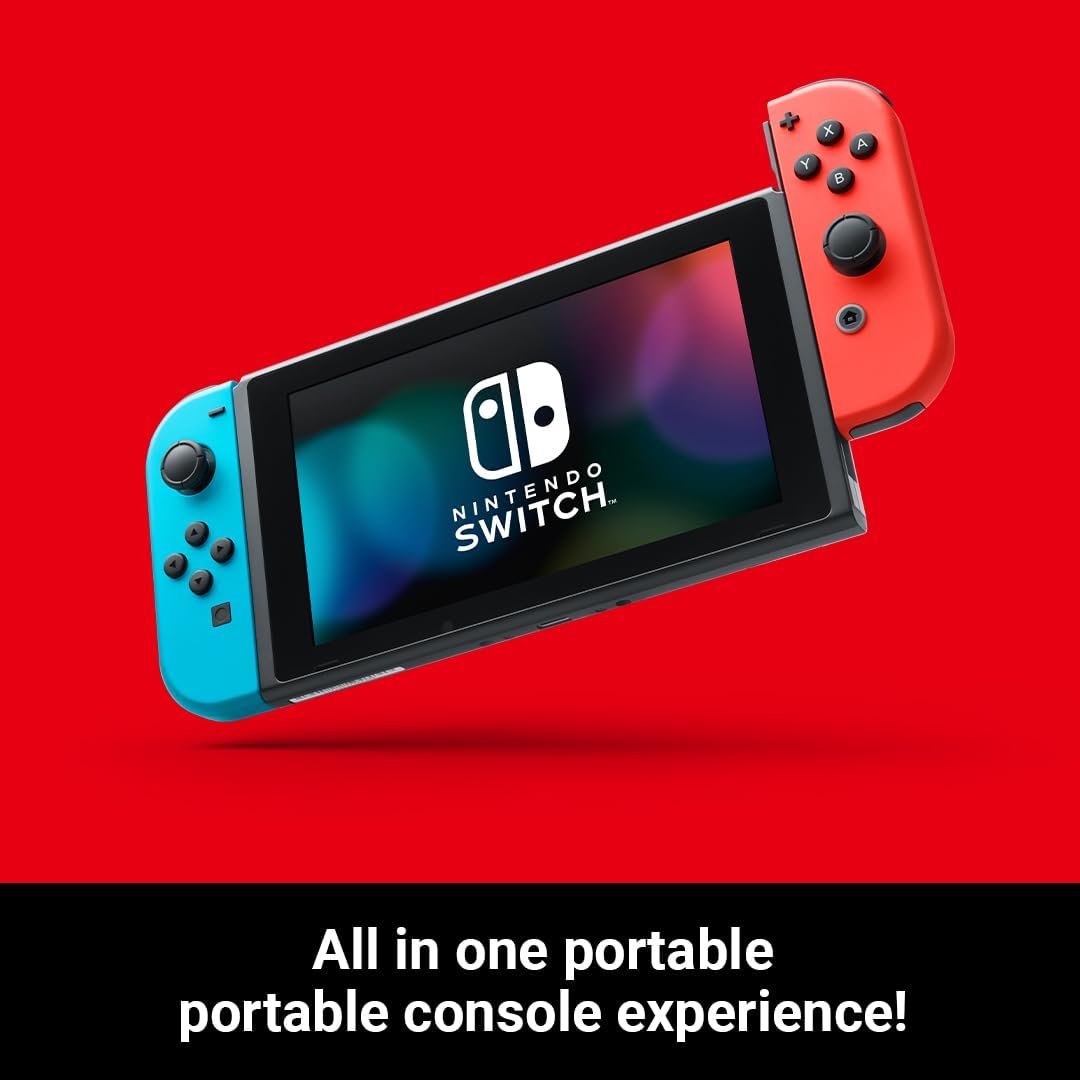
I’ve been using this Nintendo Switch (Neon Red/Neon Blue) as my main console for a while now, and the short version is: it’s not perfect, but it fits real life pretty well. I don’t always have time to sit in front of the TV for hours, and that’s where this thing makes sense. You can dock it, play on the sofa, then pull it out and keep going in handheld mode when someone wants the TV or you need to move.
What struck me after the first few days is how casual it feels to pick up. With a PlayStation or Xbox, I kind of plan a session. With the Switch, I just hit the power button, and in a couple of seconds I’m back in my game. On the train, in bed, or in the kitchen while something cooks, it’s just “grab and play”. It sounds basic, but in practice it changes how often you actually use it.
Of course, there are trade-offs. It’s not the most powerful console out there, and you see that quickly if you’re used to 4K graphics and super smooth framerates. Some games look a bit soft on the TV, and a few titles struggle more than others. If you’re obsessed with graphics, you’re going to notice. If you mainly care about playing Nintendo exclusives and some indie games, it’s easier to accept.
Overall, my feeling is that this Switch is a pretty solid everyday console: strong on flexibility and portability, weaker on raw power and online features. If you go in knowing that, you’ll probably be happy. If you expect a mini high-end gaming PC, you’ll be disappointed. For me, it’s become the “always on hand” console that gets the most use, even though I own more powerful systems.
Value for money: worth it if you want Nintendo games and portability
On value, it really depends what you’re expecting from the console. The Switch isn’t cheap, especially once you add a game or two and maybe a microSD card, but you’re paying for the hybrid concept and Nintendo’s exclusive games. If you mainly want to play titles like Zelda, Mario, Pokémon, or Animal Crossing, there’s no alternative: this is the machine you need. In that sense, it’s decent value, because these games keep their interest for a long time and don’t drop in price quickly, so you can resell them easily if you buy physical copies.
Compared to other consoles purely on power, the Switch is weaker for roughly similar money, so if you only care about graphics and big third-party games, it’s not the best deal. But that’s not really what it’s trying to be. You’re paying for the flexibility: TV mode, handheld mode, and quick multiplayer with the two Joy-Con. If you actually use all those modes, it feels like you’re getting good use out of your money. If you only ever play docked on the TV, then the value is less clear, because you’re not using its main advantage.
There are some hidden costs though. Extra controllers are not cheap, Joy-Con replacements are pricey, and many people end up buying a Pro Controller for better comfort in docked mode. Online play also requires a Nintendo Switch Online subscription for most multiplayer, even if it’s relatively cheap compared to other platforms. Add a protective case and a screen protector, and the total bill climbs.
Personally, I think the Switch offers good value for someone who wants a flexible console and likes Nintendo’s style of games. If you’re more into realistic shooters, sports sims with top graphics, or you don’t care about playing on the go, then a different console may be a better investment. For mixed use (sofa, bed, travel) and family-friendly gaming, the price makes sense, even if the hardware itself is not the most powerful on paper.
Design: practical, a bit toy-like, but it works
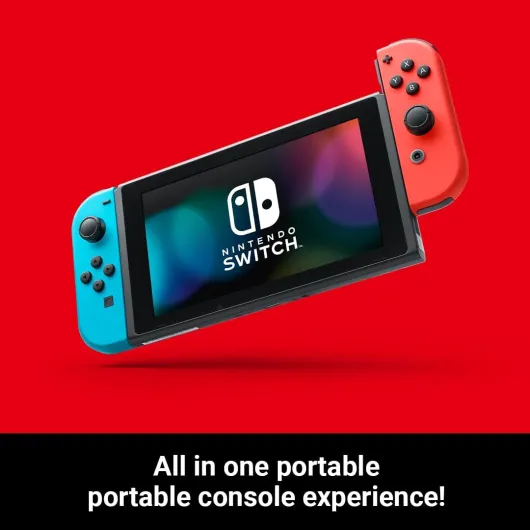
The design of the Switch is pretty straightforward: a 6.2-inch screen in the middle and rails on each side where the Joy-Con slide in. The neon red and neon blue controllers give it a fun, slightly toy-like look. If you’re coming from a sleek black PlayStation or Xbox, it can feel less “serious”, but honestly, after a few days I stopped caring and even liked being able to spot it easily in my bag or on the table.
In handheld mode, the console is reasonably compact and not too heavy. You can hold it for a good hour without your wrists complaining too much. The bezels around the screen are a bit thick by today’s standards, but in real use you stop noticing. The buttons and sticks are all within easy reach. The layout is classic Nintendo: nothing fancy, but it’s logical and easy to get used to, even if you haven’t touched a Nintendo console in years.
There are some design choices that feel dated though. The kickstand on the back for tabletop mode is thin and not very reassuring. It works on a flat, stable surface, but on a train or on a soft surface like a bed, it’s pretty useless. Also, all the ports are basic: a cartridge slot, a headphone jack, and USB-C on the bottom. No Ethernet port on the console itself (you need an adapter via the dock if you want wired internet), and the speakers are just okay, nothing more.
Overall, I’d describe the design as practical and clearly thought out for portability, but with some compromises. It feels more like a neat gadget than a premium object. Personally, I’m fine with that because it’s light and easy to use, but if you love super polished hardware with metal finishes and thin edges, this won’t impress you. It’s built to be thrown in a bag and used, not admired on a shelf.
Battery life: decent, but varies a lot by game
Battery life is one of those things where it really depends on what you play and how bright you set the screen. In my experience, with lighter games or 2D indies and the brightness at around 50–60%, I get roughly 4–5 hours of handheld play. With heavier 3D games like Zelda or Mario Odyssey at higher brightness, it drops closer to 2.5–3.5 hours. So it’s not an all-day machine, but it’s fine for commutes, evenings in bed, or a flight if you’re careful.
Charging is done via USB-C, which is convenient. You can use the included charger, or a decent third-party USB-C charger if you’re careful with power ratings. From low battery to full, you’re looking at around 3 hours while playing less or in sleep mode. If you leave it docked, it stays topped up, so at home it’s not really a problem. The only time it annoyed me was on long trips when I forgot a power bank; you suddenly realize how quickly a couple of long sessions can drain it.
One thing I like is that sleep mode is very efficient. You can just tap the power button, throw it in a bag, and come back later with very little battery lost. It feels more like pausing a phone than shutting down a console. That encourages quick sessions, because you’re not worried about a long boot time or big battery drain while it’s idle.
Overall, I’d call the battery life acceptable but not impressive. It gets the job done for normal use, but if you’re planning a full day of heavy gaming away from a plug, you’ll want either a power bank or to lower the brightness and manage your expectations. Compared to other portable devices, it’s in the middle: better than some gaming laptops unplugged, weaker than a pure handheld designed only for battery endurance.
Durability: solid console, but Joy-Con are the weak point
In terms of durability, the main Switch unit feels reasonably solid. It’s plastic, but it doesn’t creak much, and after being thrown in bags and used on the go, mine has held up pretty well with just a few small scratches on the back. The screen is plastic-coated, so it’s more resistant to shattering than glass but scratches more easily. I’d strongly recommend a cheap screen protector; without it, even wiping it with the wrong cloth can leave micro-scratches over time.
The real issue, and this is pretty widely known, is the Joy-Con durability. They feel fine at first, but after some months of use, Joy-Con drift can appear (the stick starts moving on its own, even when you’re not touching it). It doesn’t happen to everyone, but it’s common enough that I’d say it’s a risk you should be aware of. I’ve had one Joy-Con start drifting after about a year of regular use. You can try cleaning or recalibrating, but often you end up needing a repair or replacement.
The rails where the Joy-Con slide in have stayed tight on my unit, no wobbling or looseness beyond a tiny bit of play that you only notice if you shake it. The buttons and triggers have held up well too; they still click fine after many hours of Mario Kart and Smash. The dock also feels basic but sturdy enough, and I haven’t had any issues with it scratching the screen, though I’m careful when sliding the console in.
Overall, I’d say the Switch is reasonably durable if you treat it with normal care, but you should budget mentally for possible Joy-Con problems in the long run. A case and a screen protector are, in my opinion, mandatory if you plan to carry it around a lot. It’s not fragile like a piece of glass, but it’s not a brick either. It survives everyday life, but long-term wear shows mostly on the controllers.
Performance: good for Nintendo games, limited for heavy stuff
On the performance side, you have to be clear: the Switch is not competing with a PS5 or a gaming PC. It’s closer to a decent mobile device that’s been turned into a console. For Nintendo exclusives like Zelda, Mario Kart, Animal Crossing, and most indie games, it does the job well. The games are usually optimized for the hardware, so they run fairly smoothly, even if the resolution isn’t super sharp on a big 4K TV.
Where you feel the limits is with more demanding third-party games. Some big titles that were ported over have lower resolution, drops in framerate, and textures that look a bit muddy. If you’ve played the same game on another console, you’ll see the difference immediately. For some people, that’s a dealbreaker. For me, I just avoid buying heavy AAA games on Switch if I know I’ll care about graphics. I keep it for games that suit the hardware.
Loading times are decent but not lightning fast. With a good microSD card, you can improve things a bit, but don’t expect the instant loading you see on newer consoles with SSDs. Menus and the system interface stay responsive though; navigating the home screen and switching between games is quick and simple. The OS is stripped down but efficient, which I actually prefer to bloated menus full of ads and random sections.
In short, the performance is enough for what the Switch is meant for: portable and casual-friendly gaming, plus Nintendo’s own big titles that are designed around its limits. If your main priority is ultra-detailed graphics and high framerates, this won’t satisfy you as a main console. But as a second machine or a portable option, the performance is acceptable and you quickly adapt to it.
What you actually get with this Switch
Out of the box, you get the main Switch tablet, two Joy-Con controllers (one neon red, one neon blue), the dock, a Joy-Con grip, HDMI cable, and the power adapter. No surprises, no extras. There’s no game included, so keep in mind you’ll need to buy at least one title or download something free to actually use it beyond the menu. The 32 GB internal storage also fills up fast, so I’d almost say a microSD card is part of the real cost if you plan to download a few big games.
The concept is simple: the tablet is the console, and the dock is just a box that connects it to the TV and charges it. You slide the Switch into the dock, and the image switches to your television. Pull it out, and it instantly goes back to the built-in screen. In practice, this swap is smooth and takes a couple of seconds. I’ve done it mid-game many times without any real issue. It really feels like one device with two ways to play instead of two separate setups.
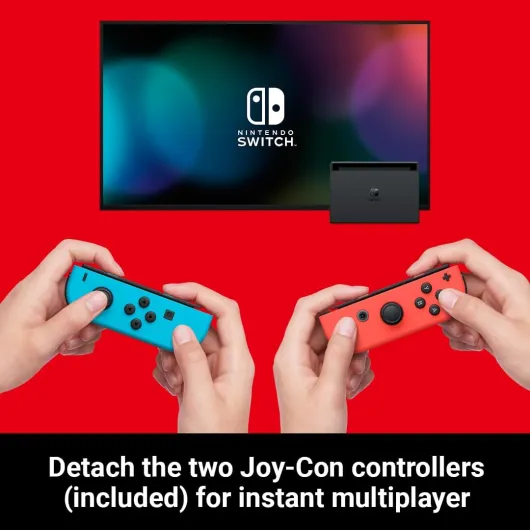
The Joy-Con system is the other key part. You can use them attached to the console in handheld mode, slide them into the grip to mimic a regular controller, or hand one to a friend so you each have a tiny controller. This last option is clever but a bit cramped if you have big hands. It’s good enough for quick Mario Kart or Smash sessions, but I wouldn’t play long RPGs that way.
Day to day, the Switch slots pretty easily into different situations: quick solo play on the bus, family Mario Kart on the TV, or tabletop mode on a small table with the kickstand. It’s very much a “Swiss army knife” console. Just don’t expect advanced media features like a full streaming box or super polished online services. It focuses on games first, and everything else is fairly basic.
Pros
- Hybrid design that lets you switch quickly between TV, handheld, and tabletop modes
- Strong library of Nintendo exclusives and indie games that suit the hardware well
- Portable, easy to pick up for short sessions, and simple interface
Cons
- Joy-Con durability issues (drift) are common and can lead to extra costs
- Weaker performance and graphics compared to other modern home consoles
- Battery life is only average for heavy games in handheld mode
Conclusion
Editor's rating
After living with the Nintendo Switch (Neon Red/Neon Blue) for a solid stretch, my conclusion is pretty straightforward: it’s a very practical console that fits around real life, with clear limits on power and some long-term concerns around the Joy-Con. The ability to go from TV to handheld in seconds is not just a gimmick; it genuinely changes how often you play, because you can squeeze in sessions where a traditional home console would just sit there unused. For people with busy schedules, kids, or shared living rooms, that flexibility has real value.
If you’re mainly into Nintendo exclusives, local multiplayer with friends or family, and portable gaming on trips or commutes, the Switch makes a lot of sense. You’ll accept the lower resolution, the sometimes rough performance on certain ports, and the need to maybe fix or replace Joy-Con later. On the other hand, if you’re chasing the best graphics, super stable high framerates, and deep online features, this console will feel limited and a bit behind the times. In that case, it works better as a second system rather than your only one.
So, who should buy it? People who want a flexible, easy-to-use console with strong first-party games and real portability. Who should skip it? Those who mostly play big third-party AAA titles on a TV and don’t care about handheld play. For me, despite its flaws, it ends up being the console I actually use the most, simply because it’s always within reach and doesn’t demand a whole setup ritual every time I want to play.