Summary
Editor's rating
Value: good handheld for the price if you accept the limits
Design: compact, nice-looking, but with some clear compromises
Battery life: decent but depends a lot on what you play
Comfort: great for long handheld sessions, with a few small annoyances
Durability: sturdy enough, but the integrated controls are a risk
Performance: same Switch guts, just in a smaller shell
What you actually get with this Switch Lite
Pros
- Lighter and more comfortable for long handheld sessions than the regular Switch
- Proper D-pad and solid overall controls for 2D and indie games
- Pokémon Dialga & Palkia design looks good and holds up well over time
Cons
- Handheld-only: no TV mode and no detachable Joy-Con
- Integrated controls mean potential stick drift is more annoying to fix

Specifications
View full product page →| Brand | Nintendo |
A Pokémon-branded Switch Lite I actually use every day
I’ve been using the Nintendo Switch Lite Dialga & Palkia Edition as my main handheld for a while now, swapping from a regular Switch that stayed docked most of the time. I picked this one mostly because I like Pokémon and I wanted something smaller and lighter to throw in a bag without worrying too much. So this review is not from a collector who keeps it in the box, it’s from someone who chucks it in a backpack, plays on the sofa, on trains, and in bed, and doesn’t treat it gently.
The short version: it’s a solid handheld if you already know you don’t care about TV mode or detachable Joy-Con. If you want the full Switch experience on the big screen, this is clearly not the right model. But if your reality is 90% handheld play, this thing makes more sense than I expected, especially in terms of comfort and weight. The Pokémon design is basically the cherry on top.
In day-to-day use, the biggest difference compared to the normal Switch is how it feels in the hands and how easy it is to carry. Performance-wise, it’s the same console: same games, same menus, same store, same limitations. You’re really choosing hardware form factor here, not a different ecosystem. I’ll go through design, comfort, performance, battery, durability and value, because that’s what actually matters after the first week when the new-toy effect is gone.
Overall, I’d say it’s good but not mind-blowing. It gets the job done very well for portable gaming, but there are trade-offs you really need to accept: no TV, no detachable controllers, and slightly smaller screen. If those compromise your use, you’ll be annoyed later. If they don’t, it’s a pretty solid everyday machine, especially if you like the Pokémon look.
Value: good handheld for the price if you accept the limits
On the value side, the Switch Lite in general is cheaper than a standard Switch, and this Dialga & Palkia Edition usually sits around the same price range as other special color Lites. You’re paying mainly for the form factor (smaller, lighter) and the Pokémon look, not for better specs. If you don’t care about TV mode and mostly play alone in handheld, it actually makes more sense to save the money and go Lite instead of buying the full Switch or the OLED, especially if you’re on a budget.
Compared to the regular Switch, you lose:
- Docked/TV mode
- Detachable Joy-Con (so no easy local multiplayer on one console)
- A slightly bigger screen
But you gain:
- Lighter weight and more portable design
- Proper D-pad
- Usually a lower price
For me, that trade-off is worth it because I already have a main console for the TV and I only wanted a handheld. If this is going to be your only Switch and you think you might want to play on a TV or do couch co-op, then the value drops a lot. In that case, the normal Switch or Switch OLED is a better long-term buy even if it’s more expensive up front.
The Pokémon branding is nice but doesn’t change the actual usage. There’s no special game included, no exclusive software, just the design. So if this edition is significantly more expensive than a standard color Lite where you live, I’d honestly say don’t overpay just for the artwork unless you’re a hardcore fan. At the usual price difference (or close to none), it’s a fun bonus. Overall, for someone who knows they only need handheld mode, I’d rate the value as solid. For someone unsure about how they’ll use it, I’d be more cautious.
Design: compact, nice-looking, but with some clear compromises
The main design point of this model is that it’s smaller and lighter than a standard Switch, with a unibody shell. At first, I was worried the smaller screen (5.5 inches vs 6.2 on the regular Switch) would bother me, but after a couple of days I stopped thinking about it. Text in games like Pokémon or indie titles is totally readable. In games with tiny UI like some RPGs, you notice it a bit more, but it’s still usable. The benefit is that the whole console feels easier to hold for longer sessions.
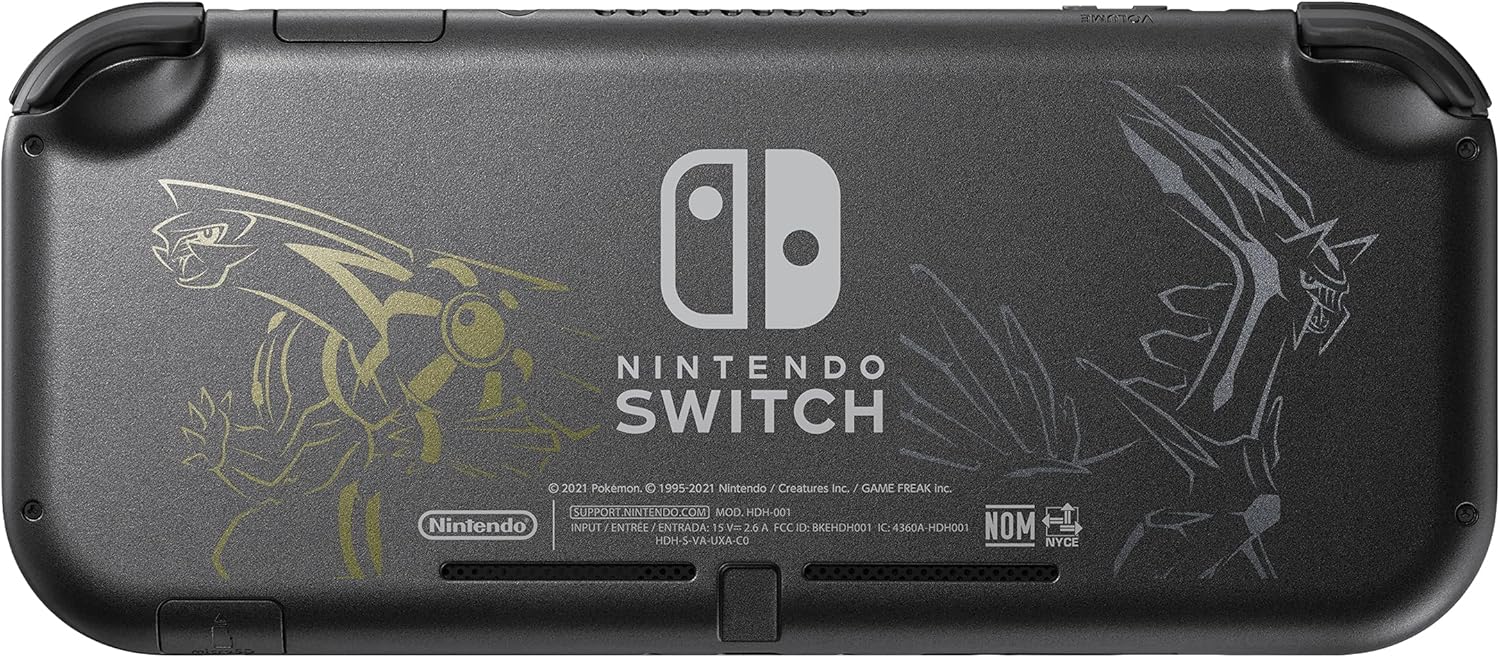
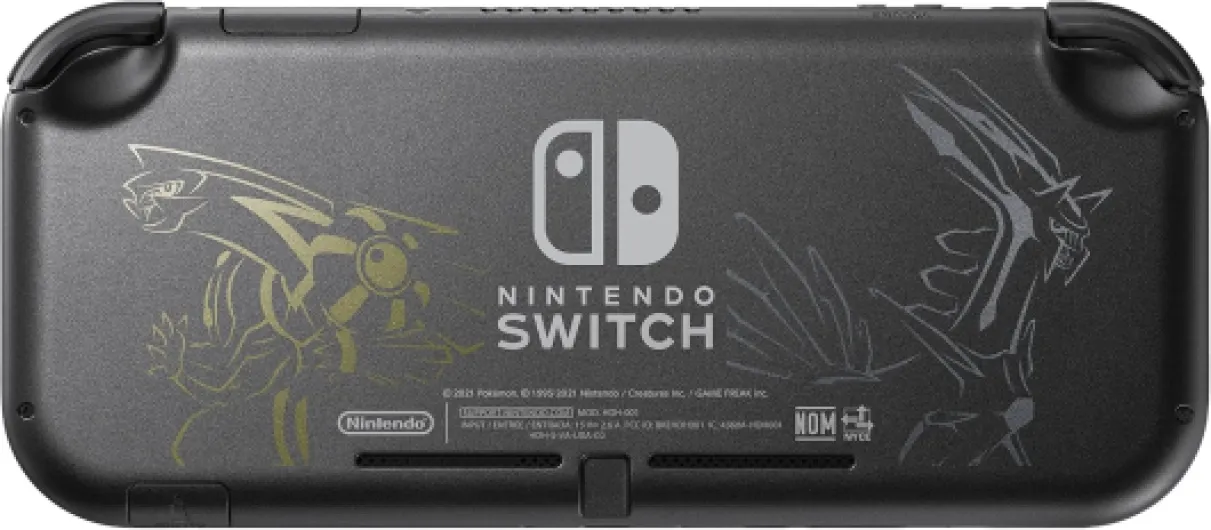
The metallic gray color is actually more matte than metallic in hand. That’s good because it doesn’t scream “shiny plastic toy”. The black buttons contrast nicely, and the Dialga and Palkia art on the back is clean and doesn’t peel or fade so far. I’ve tossed it in a bag with keys a couple of times (by mistake) and the art hasn’t scratched off, which was my concern. The shell itself can get hairline scratches, though, so a case is still smart if you care about looks.
One big design win for me is the proper D-pad on the left. Compared to the four separate buttons on Joy-Con, this is just nicer for 2D platformers, fighting games, and menu navigation. It feels more like a classic handheld (3DS, Vita style). The trade-off is you lose the flexibility of detachable controllers. If a Joy-Con stick drifts on a regular Switch, you can swap or send just that part. Here, if a stick drifts, the whole console has to go in for repair. That’s the ugly side of the unibody design.
In terms of layout, the triggers and bumpers are fine, the sticks feel similar to Joy-Con sticks, and the speakers are front-facing enough that you don’t cover them too much while playing. Nothing fancy, but it’s practical. Overall, the design is simple and functional with a nice Pokémon twist. Just be aware you’re locking yourself into handheld-only use, and repairs are less modular than with the standard Switch.
Battery life: decent but depends a lot on what you play
The battery life on the Switch Lite Dialga & Palkia Edition is fine but not impressive. Nintendo’s general claim for the Lite line is around 3–7 hours depending on the game, and that matches my experience. Playing something lighter like indie games or older titles with medium brightness, I can stretch it to around 5–6 hours. When I play heavier games like Zelda or more demanding 3D Pokémon titles, I’m usually closer to 3–4 hours before I start getting nervous and looking for a charger.
In practical terms, that means it’s totally okay for commuting, flights, or a lazy evening on the couch, but it’s not an all-day gaming machine unless you’re near a plug or carry a power bank. I’ve done a 3-hour train ride playing mostly Pokémon with Wi-Fi off and medium brightness, and finished with around 35–40% battery left. That’s acceptable, but you do need to manage brightness and wireless if you want to squeeze the most out of it.
Charging is via USB-C, which is convenient. It charges from empty to full in roughly 2.5–3 hours using the included adapter. You can also use a decent third-party USB-C charger or a power bank; I’ve done that multiple times and it works fine. The only thing to watch is that you can’t dock it to a TV, so there’s no charging dock option unless you buy some stand; you’re always plugging the cable directly into the console.
After several months, I haven’t noticed any brutal battery degradation, but like any lithium-ion battery, it will slowly lose capacity over time. If you’re the kind of person who plays a lot every single day, expect to feel that after a couple of years. For normal use, I’d call the battery acceptable but nothing special. It gets the job done as a handheld, but don’t expect miracle longevity.
Comfort: great for long handheld sessions, with a few small annoyances
Comfort is honestly where the Switch Lite makes the most sense. The weight difference compared to the regular Switch is very noticeable. After an hour of playing on the couch or in bed, my hands and wrists feel less tired with the Lite. It’s easier to hold up without constantly adjusting your grip. If you mostly play lying down or on the go, this matters more than you think. I went back to my regular Switch once and it felt clunky and heavy in comparison.
The shape of the Lite is pretty flat, which is both good and bad. Good because it slides easily into a bag or case, bad because there’s not much natural grip at the back. After about two weeks, I ended up adding a simple silicone grip case, and that made a big difference for longer sessions. Out of the box, it’s comfortable enough, but if you have larger hands, you might feel your fingers cramping a bit after a couple of hours of something like Monster Hunter or Zelda. For quick 20–40 minute sessions, it’s totally fine bare.
The buttons and sticks are okay in terms of comfort. The D-pad is pleasant to use, especially for older-style games. The face buttons are a bit on the small side, but they have a clean click. The sticks are the usual Switch style: not super precise like a high-end controller, but usable for pretty much everything. I’ve played a mix of RPGs, platformers, and shooters; aim control isn’t perfect, but it’s manageable. I haven’t had drift yet, but that can show up later, so I’m not going to pretend it’s bulletproof.
Audio comfort is average. The speakers are loud enough for indoor use, but in a noisy train they struggle a bit, so I usually plug in wired earphones. Bluetooth audio is possible with an adapter, but not built in without system updates or accessories, which is slightly annoying in 2026 standards. Still, for pure handheld comfort, I’d say the Lite beats the normal Switch easily, especially if you’re someone who plays an hour or two at a time.
Durability: sturdy enough, but the integrated controls are a risk
In terms of build quality, the Switch Lite Dialga & Palkia Edition feels pretty solid for a plastic handheld. There’s no creaking when you twist it lightly, and the unibody design means there are fewer moving parts than a regular Switch with detachable Joy-Con. I’ve tossed it into a bag, used it daily, and it hasn’t developed any weird flex or looseness. The buttons still feel the same as day one, and the triggers haven’t gone mushy.
The screen is still just plastic with a thin layer, not glass, so it will scratch if you’re careless. After a week of careful use without a protector, I already had a couple of small micro-scratches that you only see when the screen is off. I slapped a glass protector on after that and stopped worrying. My advice: just put a screen protector on from day one. It’s cheap and saves you the annoyance of visible scratches later.
The big question mark, like on any Switch, is stick drift. Because the controls are integrated, if one of the analog sticks starts drifting, you can’t just swap Joy-Con. You either live with it, try a DIY fix, or send the entire console in for repair. That’s the main downside of this design for durability. So far, mine is fine, but I know from the normal Switch that drift can show up after a year or two, especially if you play a lot of games that hammer the sticks. It’s not a guaranteed problem, but it’s something to keep in mind.
Cosmetically, the Pokémon artwork on the back has held up well. It hasn’t faded or chipped, even after rubbing against the inside of a case and occasionally against other items in my bag. The gray shell does show small scuffs over time, but nothing shocking. Overall, I’d say the console is durable enough for everyday use, as long as you protect the screen and accept that stick drift, if it happens, will be more annoying to deal with than on a regular Switch.
Performance: same Switch guts, just in a smaller shell
On the performance side, there’s nothing surprising: this Switch Lite runs exactly like a normal Switch. Same CPU, same graphics, same OS. If a game runs at 30 fps on a standard Switch, it’ll do the same here. I played Pokémon Brilliant Diamond, Shining Pearl, a bit of Arceus, plus some Zelda and a bunch of indie games like Hades and Dead Cells. Load times felt identical to my regular Switch when using the same microSD card.
Where it changes slightly is the experience of the smaller screen. Because the display is smaller but keeps the same resolution (720p), the pixel density is higher. In practice, that means games can look a bit sharper on the Lite than on the original Switch in handheld mode. It’s not a huge difference, but text and edges can appear slightly crisper. On the flip side, small text in some RPGs is even smaller, so if you’ve got weaker eyesight, that might be annoying. Brightness is okay indoors; in direct sunlight, it’s still hard to see, same as any Switch.
The console handles the Switch library that supports handheld mode. A few titles that rely heavily on Joy-Con motion or IR features are awkward or require extra controllers, but that’s not the majority. For 90% of mainstream games, you just install and play. Wi-Fi performance is standard: downloads are not blazing fast, but that’s a Switch thing in general, not specific to the Lite. Online play works fine; I didn’t notice any extra lag versus my docked Switch on the same network.
In short, there’s no performance advantage or disadvantage here apart from the way the screen feels. If you expect higher frame rates or better graphics than a normal Switch, that’s not happening. You’re basically getting the same performance in a more portable body, which is honestly all this device is supposed to be. It does that job reliably enough.
What you actually get with this Switch Lite
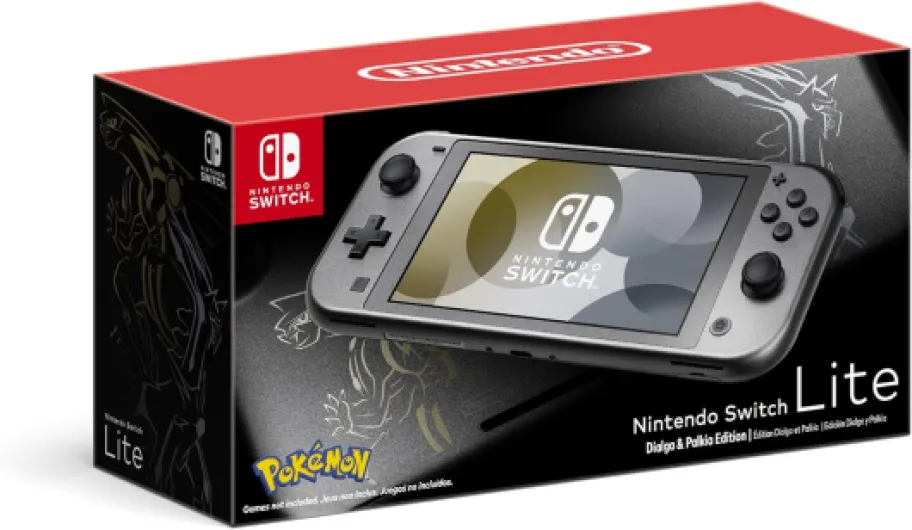
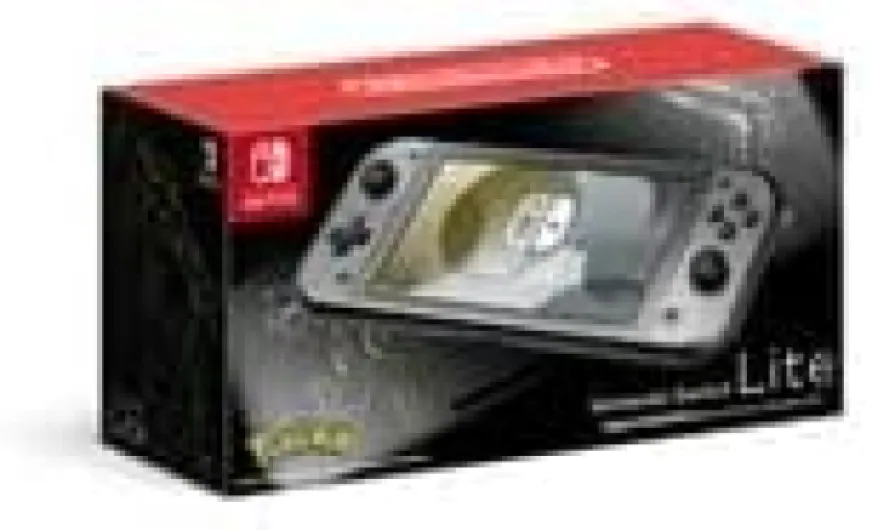
Out of the box, the Nintendo Switch Lite Dialga & Palkia Edition is pretty straightforward. You get the console, the charger, and the usual papers. No case, no screen protector, no fancy extras. It’s bare-bones, which is fine but keep in mind you’ll probably want to spend a bit more on a case and maybe a glass screen protector if you plan to travel with it. The box itself is themed with the Pokémon artwork, but that’s honestly just something you look at once and then throw in a cupboard.
The console is a metallic gray color with black buttons, and the back has line art of Dialga and Palkia in silver and gold. In real life, the drawings are actually more discreet than I expected from the photos. It looks more like a custom limited console than a kid’s toy covered in logos, which I liked. If you’re not a huge Pokémon fan, it still looks fairly neutral from the front because you mostly see the gray shell and black buttons.
Functionally, it’s a standard Switch Lite: it only does handheld mode, no docking, no TV output. It has integrated controls, a proper D-pad on the left, and the same basic layout as Joy-Con for the rest. You’ve got a microSD slot, headphone jack, USB-C charging port, and the usual volume and power buttons. It runs all Switch games that support handheld mode. A few games need separate controllers for motion stuff, but that’s more the exception than the rule. I use it for Pokémon, Zelda, indie games, and it’s totally fine.
So in terms of presentation, what you see is what you get: a themed Switch Lite, no extras, same OS and store as any other Switch. The unique part is just the color and artwork. If you’re expecting any special Pokémon software, background, or pre-installed game, forget it. Games are sold separately, and the console itself is just a normal Switch Lite with a different shell.
Pros
- Lighter and more comfortable for long handheld sessions than the regular Switch
- Proper D-pad and solid overall controls for 2D and indie games
- Pokémon Dialga & Palkia design looks good and holds up well over time
Cons
- Handheld-only: no TV mode and no detachable Joy-Con
- Integrated controls mean potential stick drift is more annoying to fix
Conclusion
Editor's rating
The Nintendo Switch Lite Dialga & Palkia Edition is a good handheld console for people who mainly want to play on the go and like the Pokémon theme. It’s lighter and easier to handle than a regular Switch, the D-pad is nicer for many games, and the Pokémon artwork looks clean without being over-the-top. Performance is the same as any other Switch, so games run as expected, and the smaller screen actually looks a bit sharper in many cases.
On the downside, you’re completely locked into handheld mode. No TV output, no detachable Joy-Con, and if a stick drifts, the whole unit needs attention. Battery life is okay but not spectacular, and you’ll definitely want to budget for a case and screen protector. If this is your first and only Switch and you think you might want to play on a TV or do regular multiplayer with friends on one console, I’d say look at the standard Switch or Switch OLED instead.
If you already know you just want a portable machine for solo play—for commuting, bed, sofa, and trips—this model makes sense, and the Pokémon design is a nice bonus if you’re into the series. It’s not perfect, but for the price and use case, it’s a pretty solid little console that does what it’s supposed to do without fuss.